For many, going abroad to volunteer seems like a dream. Getting to apply your skills in a way that aids the community development and strengthens cohesiveness while exploring the new culture? It might sound unreachable. Amazing. Scary.
Well, the last two are both true in their own ways. After 3 months in Hanoi, I can tell you that the SASID project truly is amazing. And now you might be wondering (though since you’re reading this, you might have some idea), what is SASID? The name itself stands for Solidarity Action for Sustainable and Inclusive Development, which already tells you something about the project. But to expand on it more, SASID volunteers work alongside the local volunteers to promote greater inclusion, climate action, nvironmental awareness, and to support longterm sustainable development. In Hanoi, there are many opportunities to do all that. As an example, I work at a vocational college and a vocational middle school, where I teach English alongside my fellow volunteers.
Our tasks are to prepare the lessons and then lead them, with the teachers acting as our support. CSDS, the hosting organisation, also offers Vietnamese people a chance to improve their English skills at an affordable price through 1-1 English classes with the volunteers. The profit goes to their fund for students from disadvantaged backgrounds. Beyond those options, you can also volunteer at a kindergarten and at the Vietnam Friendship Village.
The latter is a specific project where you’ll be able to work with Vietnamese people, both children and adults, who have been affected by Agent Orange and are therefore disabled. There, you’ll help the teachers in the classrooms, organise activities for the residents, and be able to implement your own ideas. The SASID project is a part of the ESC Humanitarian Aid, meaning that in order to participate in it, you have to have completed the Humanitarian Aid Face To Face Training. But, it also means that every volunteer receives funding from the European Commission, which allows us to dedicate ourselves fully to volunteering.
This all seems, like I already said, amazing. However, if you have ever volunteered before, you are for sure aware that it can also be quite daunting. Different culture, new language, strange people… All that is stressful for many of us. I still remember the day I arrived in Hanoi. Let me describe it to you.
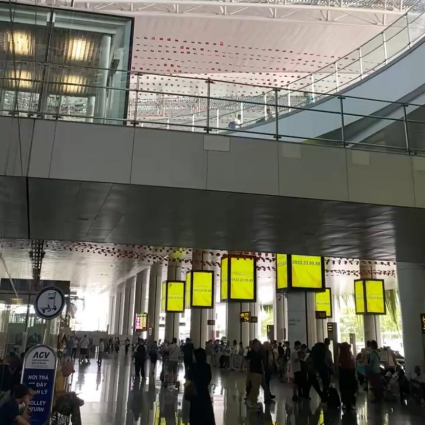
The first major difference I experienced once I arrived in Vietnam was the weather. Exhausted by a long trip, I stepped out of the airplane, only to be hit by a wave of heat and humiditya typical experience for those coming to Hanoi in September. I did some research before my departure, so I knew to expect it, but since I had never experienced a weather like that before, I was surprised that it felt like that. Then, as I made my way towards the immigration, it was the written language – familiar due to the use of the Latin alphabet, strange due to the visual presence of six tones you have only started to learn a few days before the departure (and that’s without touching on the presence of the unfamiliar vowels and the difficult pronunciationthose lessons were still ahead of me at that time). Once you pass the immigration and collect your luggage, you will begin to experience Hanoi’s flavour of chaos. Many taxi drivers will approach you, offering to take you to the city at a good price.
As a volunteer, you fortunately do not have to worry about figuring out what exactly is a good price. The hosting organisation, CSDS, will arrange a transport for you. Once you are inside the car, already a bit sweaty, you will finally have the chance to relax a bit and watch the bits of the city along the way. Or maybe you’ll go to sleep. Or read something. Listen to music.
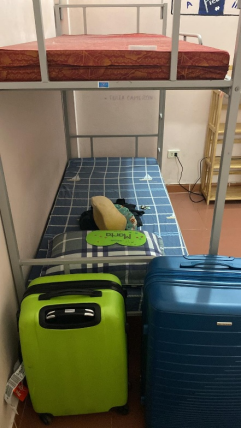
Perhaps something else altogether. Just focus on relaxing after a long trip. After you arrive, you will be greeted by one of the staff members who will help to bring your luggage to your room, explain this and that about the house, and then show you around the neighbourhood. You will also get a local sim card. Then, you can rest in your new bed. If you’d rather meet your new flatmates instead, then go ahead! Though, if it’s the middle of the morning or the afternoon, you might be out of luck, since most volunteers are busy at those times. In that case, you can visit a place you’ll most likely see at least once a week for the team meeting – the SOCI Hub Café. There’s nearly always someone there, either a volunteer or one of the local staff. But, if you are really unlucky and it’s closed, just send a text on the group chat for all volunteers. People here are very open and I’m sure at least one person will be free to hang out and talk! But even if you don’t meet any of the volunteers you’ll live with immediately, you will for sure do that during the next meal.
And see? Even though it can be kind of scary at first, there are many people here who will support you along the way! What for sure is not true is that volunteering abroad, especially in Hanoi is unreachable, though trust me, once upon a time I thought the same. I remember sitting on my bed some day in my last year at the university, with my laptop open in front of me, showing SASID projects descriptions. I decided long before that I wanted to do a gap year and dedicate it to volunteering. However, I still felt like I lacked the necessary skills. The imposter syndrome can sometimes get such a grip on you. Yet, it’s important to fight it and believe in yourself! And so, guided by this thought, I applied for several projects. Shortly after, I had my Welcome!!
interview with Clara from ICJA. Then, an interview with Phương from CSDS. Both were really good and very informative. But then I had to wait for the decision, which for me was probably the most stressful part. It was out of my control after all. After a few weeks, I received the decision – selected!
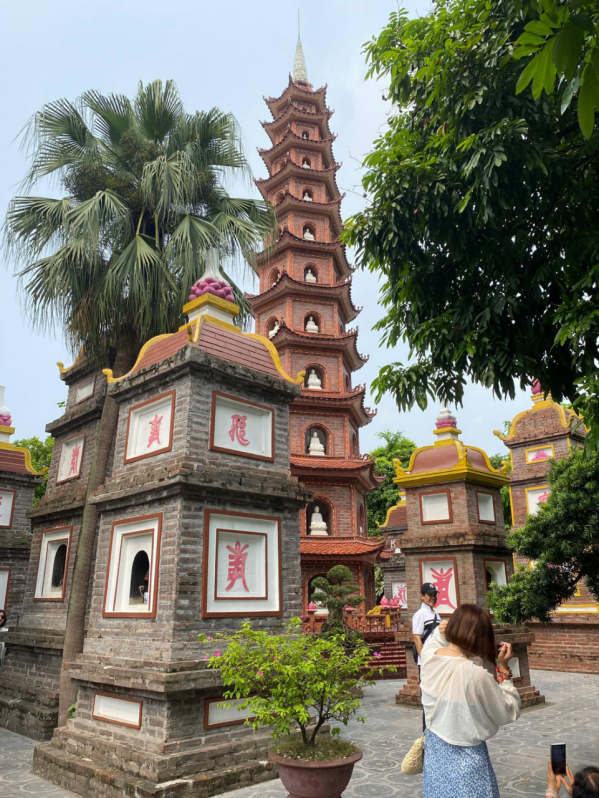
Since my arrival in September, I had a chance to do many things and try my hand at different projects. This is really what the first week is all about in general – finding what projects are the best for you (well, that and the city tour on Friday). I tried out the kindergarten, the Friendship Village, and several teaching projects. While the first two ones weren’t really my cup of tea, some of the last ones I’m still doing to this day, specifically teaching at a vocational college and a vocational high school. The lessons are meant to encourage the students to speak, so we (I’m not working alone!) try to come up with activities that will be the most suitable for that as well as for their level.
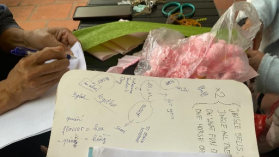
Furthermore, CSDS has relatively recently launched Language Labs (LLs). A prospective student can choose a language, choose a volunteer that is able to teach said language, and schedule a private session at the SOCI Hub Café. The price is very affordable and the 100% of it goes to the Bright Future Fund, which is CSDS’ scholarship scheme for disadvantaged Vietnamese students. It covers a part of their
tuition. There are also Community Classes, which are usually organised by more than one volunteer and are attended by a group of Vietnamese people. They are very eager to learn, which makes them amazing students. But, my time to work on the Community Classes is yet to come, so maybe I’ll describe it more in detail some other time.
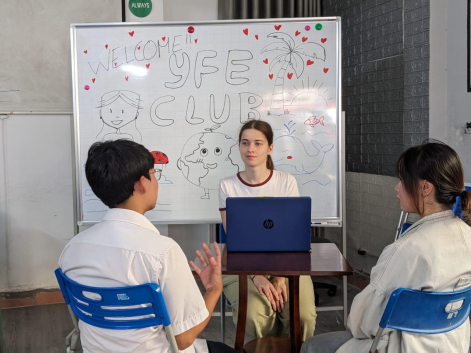
Just in November we started another exciting project called Youth for Earth Club (YFE). It’s a community
meant for young people passionate about tackling climate change. The idea is that through small actions we will raise the awareness about climate change in the local community, which will eventually lead to a shift in the mindset of the general population. During the kick- off meeting we were able to choose
our preferred topics related to climate change and we formed groups with at least 1 long-term volunteer in each. Every group was able to choose a month during which they will lead thematic activities. Me and my groupmates chose a topic about air pollution and green commuting which we will do in March.
Being a part of CSDS is not just about volunteering. Thanks to them, we have been invited to seminars hosted by embassies. For example, in October we have been invited by the Embassy of Denmark to a seminar about sustainable fashion. It was a great opportunity to learn more about fashion industry and what are the ways we can make it more sustainable. Or, in September, very soon after our arrival, we participated in the World Clean-Up Day. You can check out more on the CSDS’ social media, where each month we share with everyone the activities of the SASID project.
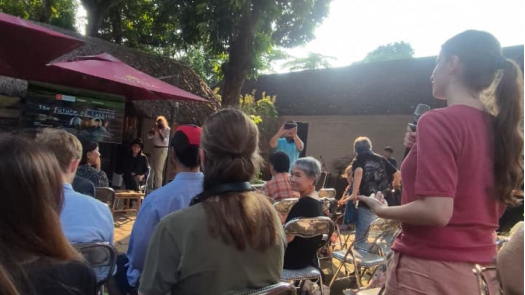
Most importantly, though, it is about community. Here, you will get to meet people that will create a long-lasting impact on you. You will become a part of a community focused on making a difference. And I believe that that’s a really precious thing. Strength is in numbers. And only together can we create a meaningful, sustainable change.