As an architect working in Istanbul, I never imagined that one day I would find myself in the kitchen of a Montessori school in a small town in Czechia, chopping salad with children. But that is exactly the kind of surprise the ESC (European Solidarity Corps) is full of.
My name is Beria. As a volunteer sent by Pi Youth Association and hosted by Spolek Hnízdo in Brno, I spent eight months at a Montessori primary school in the town of Tišnov. This is a summary of what I saw, experienced, tried, and learned during those eight months.
English in the Classroom: Not as a Language, but as a Tool
English was at the core of my role, but what I want to describe was far from a traditional language class. The school had an approach called “Lusk English”: you take the topic of the week—whether it is history, chemistry, biology, or anything else—and explore it entirely in English.
Each week, I chose a topic and presented it through games, visuals, and short presentations to make the lessons more engaging. In other words, the children were not listening to English simply to learn the language; they were listening to English in order to learn something. It may sound like a small difference, but in reality, it makes a big one.
Another part of the Montessori system was the time spent in the kitchen. Twice a week, the children prepared their own lunches, and I joined them during those hours—sometimes explaining a recipe, sometimes simply chatting while we cooked together.
What an Architect Can Bring to the Classroom
Up to this point, my experience might sound similar to what many volunteers in this kind of program could describe. What made my experience different was the opportunity to bring my background in architecture into the classroom. We offered the children several small workshop options, and everyone was free to choose the group that interested them the most.
In one group, I taught them the classic technique of collage using old newspapers and magazines found at home. Considering how accustomed today’s children are to digital tools like Canva, creating something with scissors and glue felt completely different and new to them.
In another group, we explored lavis, a drawing technique created using different shades of a single color.
The third group chose a movie they loved and recreated its poster on the computer using their own designs while paying attention to basic principles of graphic design.
These workshops were repeated in several rounds. No one was forced to participate, and everyone was free to choose whichever group they preferred. For me, this was the first time I had the opportunity not only to be a “volunteer teacher,” but also to share my own profession and creative background with a different age group and in a different language.
Of Course, There Were Challenges Too
Communicating in English with everyone was not always easy. In those moments, I either managed with gestures and body language or relied on the few Czech words I had learned—such as hello, thank you, and have a nice day—to get by.
Two Moments I Will Remember for a Long Time
The first was hearing the children say, “This was so much fun, let’s do it again,” after my workshops. It may seem like a small thing, but in that moment, I felt that what I was doing truly had an impact.
The second was the first week I spent getting to know the other volunteers in Tišnov. At that point, I knew almost nothing about ESC. I was in a foreign country, and that community helped guide me. For the first time in my life, I found myself surrounded by and having conversations with people from so many different countries at the same time—an experience I could never have had under any other circumstances.
A Few Words About Brno and Tišnov
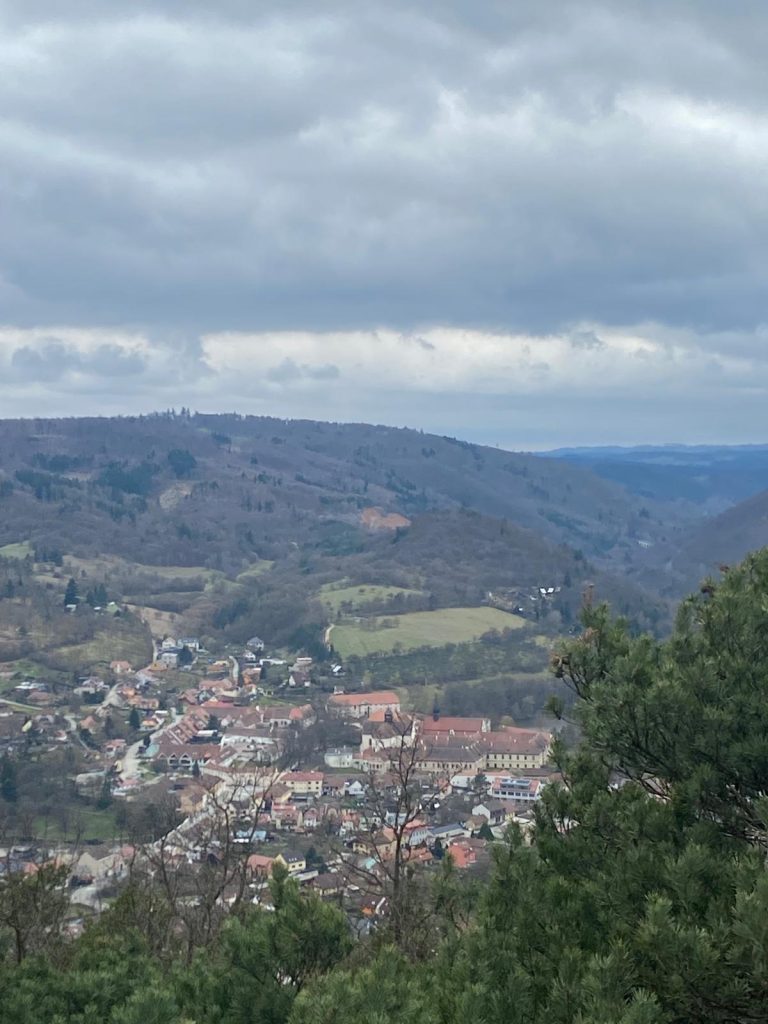
Brno is the second-largest city in Czechia, and it never makes you feel isolated—you can find everything you need there. Tišnov, on the other hand, is a little further from the city center, but it is a peaceful and pleasant town with its own unique charm.
The people around me—volunteers, teachers, and neighbors—were always supportive. Czech cuisine was different from what I was used to, but overall, I really enjoyed it. In my free time, I had the opportunity to visit Prague, Karlovy Vary, Mikulov, Lednice, and Moravský Krumlov, as well as taking a short trip to Vienna.
What Remains
Using my knowledge of architecture with a completely different age group and in a completely different context gave me a new professional perspective. On a personal level, getting to know different cultures, people, and values up close broadened my horizons.
And perhaps the most concrete result is this: after this experience, my perspective on volunteering has completely changed. I now look at new volunteering opportunities with much more enthusiasm.
If you are thinking about joining ESC, I would recommend giving it a try without hesitation. Even if you begin without expecting anything in return, you will still come away with something of your own. Moreover, the fact that the rights and responsibilities within the program are clearly defined provides a secure and reliable framework for the experience.
I would like to thank Pi Youth Association for making this experience possible, as well as Spolek Hnízdo, who hosted me in Brno, and everyone at the school for their support and warmth.